If you are selling a house in Maryland, the smoke alarms have to meet the state smoke alarm law before the transfer. The rule that catches people is simple: alarms more than 10 years old have to be replaced, a hardwired alarm has to stay hardwired, and the house needs coverage on each level, including the basement. Where the alarms go, and whether they can be battery-powered, depends on the year the house was built.
This is general information from Maryland Public Safety Article §9-103 and §9-104, plus the way Baltimore County and the state describe the law for existing homes. It is not legal advice. Before settlement, confirm the details with the local fire marshal or your title company. If the alarms are expired, missing, or the wrong type, smoke and carbon monoxide detector installation is the repair we do for sellers across Greater Baltimore.
The rule sellers actually fail
Maryland required existing homes to be upgraded by January 1, 2018. For a sale today, that upgrade is the standard the house is measured against:
- At least one smoke alarm on each level, including the basement. Unoccupied attics, garages, and crawl spaces are excluded.
- At least one smoke alarm in each sleeping area. Newer houses also need one in the hallway outside the bedrooms, and inside each bedroom.
- Replace any alarm that is more than 10 years from the date of manufacture printed on the back. If you cannot find a date, replace it. The sensor gets unreliable with age even when the test button still beeps.
- Hardwired alarms are replaced with hardwired alarms. Taking one down and sticking a battery unit in its place does not satisfy the law.
- Where a battery alarm is allowed, it has to be a sealed, tamper-resistant unit with a long-life battery and a hush button. Loose 9-volt batteries do not qualify.
The State Fire Marshal, a county or municipal fire marshal, a fire chief, or the Baltimore City Fire Department enforces the subtitle. Listing agents treat the condition of the alarms as a material fact, which is why this shows up in the disclosure and again at the buyer’s inspection.
Where the alarms go, by the year the house was built
Baltimore’s housing stock spans all of these eras. A Federal Hill rowhouse and a 2015 house in Howard County are not held to the same placement rule.
| When the home was built | Power source | Placement |
|---|---|---|
| Before July 1, 1975 | Battery or hardwired. Battery units must be sealed, 10-year, with a hush button. | Each sleeping area, plus one alarm on each level including the basement. |
| July 1, 1975 through June 30, 1990 | Hardwired AC. | Sleeping areas. Homes from January 1, 1989 onward also need an alarm on each level, and those alarms have to sound together. |
| July 1, 1990 through June 30, 2013 | Hardwired AC with battery backup. | Sleeping areas, each level, interconnected so one alarm sets off the others. |
| On or after July 1, 2013 | Hardwired AC with battery backup, interconnected. | Inside each bedroom, outside the sleeping rooms, and on each level including the basement. |
Two details change jobs in older city houses. First, a location the 2018 upgrade newly required, where no alarm existed before, may be a sealed 10-year battery unit. Second, an alarm that is already hardwired stays hardwired even in a pre-1975 house. If your 1920 rowhome was wired for alarms later, those heads get replaced with hardwired heads.
Homes built on or after July 1, 2013 follow §9-103 directly: a smoke alarm in each sleeping room, in the hallway or common area outside the sleeping rooms, and on each level. If two or more are required, activating one has to activate all of them. Each one runs on household power with a battery backup.
Carbon monoxide is a separate statute
Buyers often ask for carbon monoxide alarms in the same breath as smoke alarms. Maryland’s carbon monoxide law, Public Safety §12-1102 and §12-1104, does not cover every house.
It applies to a dwelling that burns fossil fuel for heat, ventilation, hot water, or a clothes dryer and was newly built under a permit issued on or after January 1, 2008. It also applies to hotels, lodging or rooming houses, and rental dwelling units. When it applies, the alarm goes in a central spot outside each sleeping area. Rentals have a stricter layout: outside each sleeping area and on every level, including the basement.
An owner-occupied Baltimore house built decades before 2008 is not automatically under that subtitle just because the furnace is gas. Inspectors, buyers, and some lenders still expect a CO alarm when the house has gas heat, a gas water heater, a fireplace, or an attached garage. A combination smoke and CO alarm is allowed when the device meets the smoke-alarm rules and the UL standards called out in §9-106 and §12-1103. We install combination units on smoke and CO jobs when that is the cleanest way to cover both.
What to fix before the buyer’s inspection
Walk the house with a step stool and read the date on the back of every alarm. Then check three things:
- Is there an alarm on every level, including the basement, and in each sleeping area?
- Is any hardwired alarm older than 10 years, painted over, or chirping?
- Did someone replace a hardwired head with a battery unit?
If the answer to any of those is yes, fix it before the inspection rather than during the repair negotiation. On a house that already has alarm wiring, replacing expired interconnected heads is a short visit. Fishing new cable to bedrooms in a brick rowhome is a larger job, and it needs a look at the attic, closets, and panel before anyone can price it honestly.
Real estate investors run into the same list at every turnover, with the added rental rule for carbon monoxide. A home electrical inspection is the right visit when the panel, the outlets, and the alarms all have to be ready for a buyer at the same time.
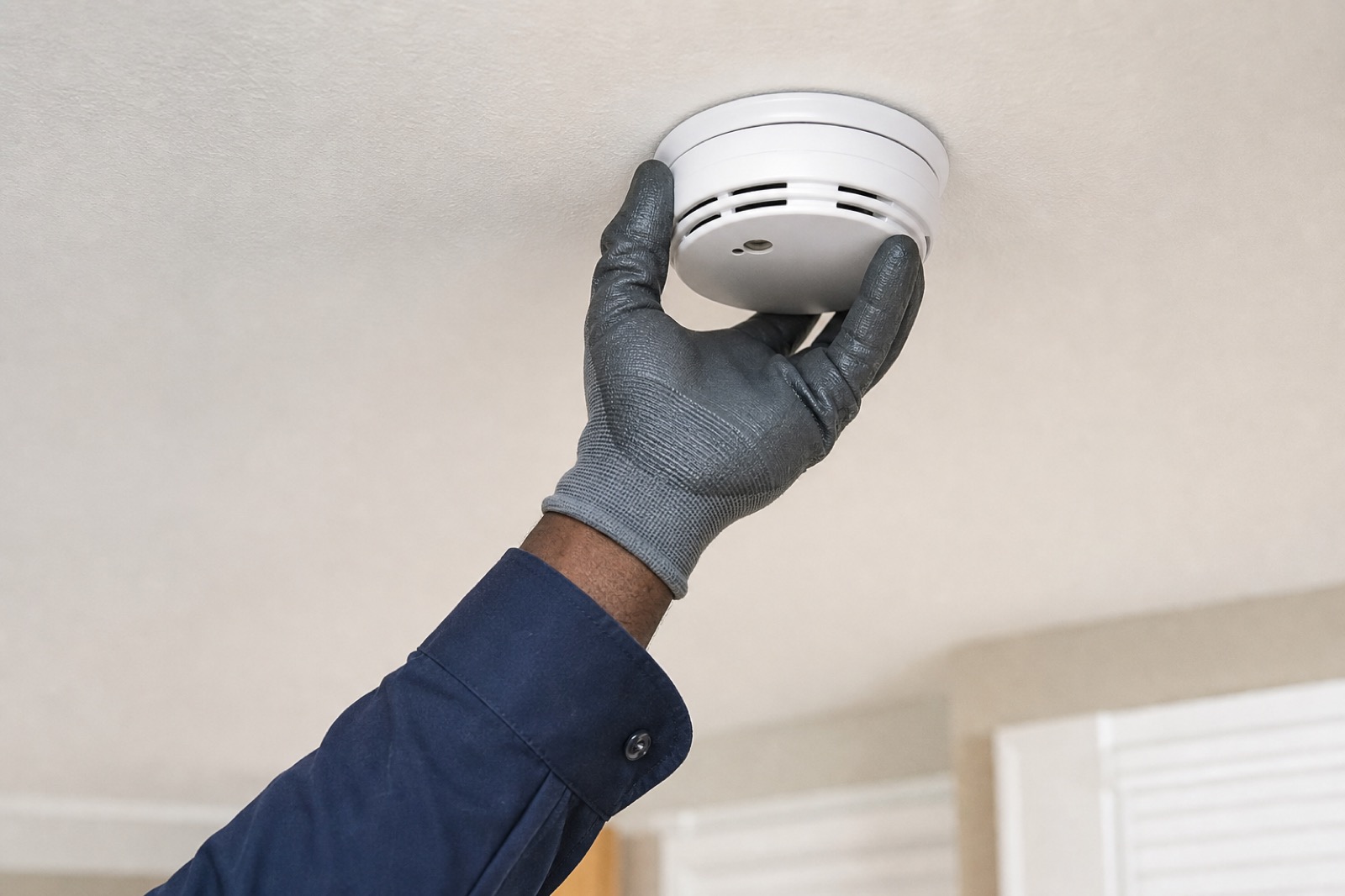
If you are listing a house in Baltimore City, Baltimore County, Howard County, or Anne Arundel County, schedule the alarm work or call (443) 423-9876. The photo on this page is from detector installation serving Timonium and north Baltimore County. We will tell you which alarms the house actually needs, and which ones a battery unit is allowed to cover.